October 29, 2029 | Mark Luis Foster
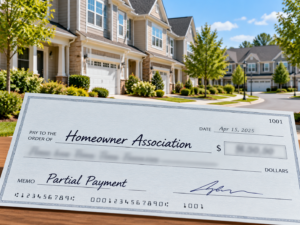 Imagine a homeowner owes your association $1,000 in overdue assessments and fees. They’re experiencing financial difficulties, and they offer to pay $400 toward their balance. Can your HOA refuse the payment because it doesn’t cover the entire amount?
Beginning January 1, 2027, Minnesota’s new HOA legislation, SF 1750, will generally prohibit covered associations from refusing partial payments, regardless of how much the homeowner offers. This is an important change that HOA boards and property management companies need to understand.
What Does the New Law Require?
Under SF 1750, enacted as Chapter 82, Minnesota’s Common Interest Ownership Act (MCIOA) is amended to require associations to accept payments of any amount toward assessments, fines or fees. There is an exception when the association has already commenced foreclosure proceedings under Minnesota law.
Importantly, accepting a partial payment does not mean the HOA forgives the remaining balance or gives up its legal rights to collect it.
The homeowner remains responsible for the unpaid amount.
How Must Partial Payments Be Applied?
Another significant change involves how associations credit payments.
Under the new law, payments generally must be applied in this order:
- Regular assessments for common expenses.
- Special assessments.
- Fines, fees and other charges.
For example, suppose a homeowner owes $600 in assessments and $200 in fines and fees.
If that homeowner pays $400, the association generally must apply the entire amount toward assessments rather than using it to pay outstanding fines first.
The law permits different payment arrangements when the association and homeowner agree. It also provides limited exceptions for certain serious violations involving health, safety, property damage or prohibited financial activities when fines remain unpaid for more than 120 days.
New Limits on Late Fees and Interest
SF 1750 also establishes limits on charges associated with delinquent assessments.
Beginning January 1, 2027:
- Late fees: Cannot exceed the greater of $20 or 5% of the amount owed.
- Interest: Cannot exceed 8% on delinquent regular or special assessments.
- Payment plans: Associations must consider offering reasonable payment plans for delinquent balances.
These changes are intended to give homeowners opportunities to address financial difficulties without allowing additional charges to escalate unnecessarily.
What Should HOA Boards Do Now?
With the January deadline approaching, boards should review their collection procedures and coordinate with property managers.
Four steps are especially important:
- Update collection policies to reflect the new payment requirements.
- Review accounting software to ensure partial payments are credited appropriately.
- Evaluate late fees and interest rates for compliance with the new limits.
- Establish procedures for considering payment plans while protecting the association’s financial interests.
Boards should also consult legal counsel to determine which provisions apply to their association.
Finding the Right Balance
HOA assessments pay for essential services, including insurance, snow removal, maintenance and reserve funding. Every homeowner’s financial contribution matters.
But unexpected financial hardship can happen to anyone.
SF 1750 recognizes that accepting partial payments can help homeowners work toward resolving their obligations while allowing associations to recover money needed to operate their communities.
For Minnesota HOA leaders, the message is straightforward: Prepare your policies, educate your management team and ensure your collection practices are ready for January 1, 2027.
Learn more: Visit the HOA Leadership Network SF 1750 Education Center for additional information and educational resources.