October 2, 2026 | Mark Luis Foster
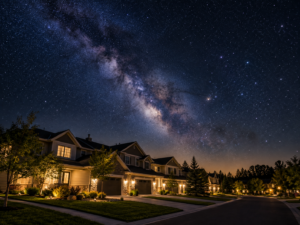 The vistas of the sky I remember from childhood were breathtaking. I grew up in rural Wisconsin where street lights were few and car headlights were as dim as a flashlight bulb low on batteries, so the sky was always a wondrous visual playground. Any trip to northern Wisconsin or Minnesota also produced amazing views of the night sky and what lies beyond. I learned a lot from my brothers who pointed out myriad constellations, orbiting satellites and an occasional meteor streaking by.
But our world is quickly eliminating those terrific views. According to Yahoo News:
A sky that once showed you 250 stars may now reveal barely 100 from the same spot. A peer-reviewed study published in Science in 2023 found that artificial night-sky brightness increased roughly 9.6% per year across the study’s participating locations between 2011 and 2022, with North America tracking even faster at 10.4% annually.
Ten percent every year is a terrifying clip rate.
Are HOAs to blame? We are part of the equation, no doubt. LED bulbs as security lights on common grounds, on garages, pathways and parking areas all contribute. I remember a Christmas holiday where nearly every home in my HOA was lit up and likely visible from space.
But certainly when it comes to HOAs, we have nothing compared to the big box retailers and their ever-expanding, well-lit parking lots upon which you could land an airplane. Turns out LEDs are to blame. Higher efficiency but extreme interference in sky watching:
LED conversion reduces electricity use per fixture. The International Dark-Sky Association identifies the actual drivers of harmful outdoor lighting as improper direction, excessive brightness, excessive duration, and inappropriate color temperature. Energy efficiency addresses none of those four factors directly.
So how can we help fix it?
Shielded fixtures that direct light downward, warmer color temperatures, motion sensors, dimmer settings, and curfews on nonessential lighting are all available today. None require waiting for new technology.
If the measured rate continues, the next generation of urban residents may never know what 250 stars look like from their own backyard.
You can read the whole story HERE.